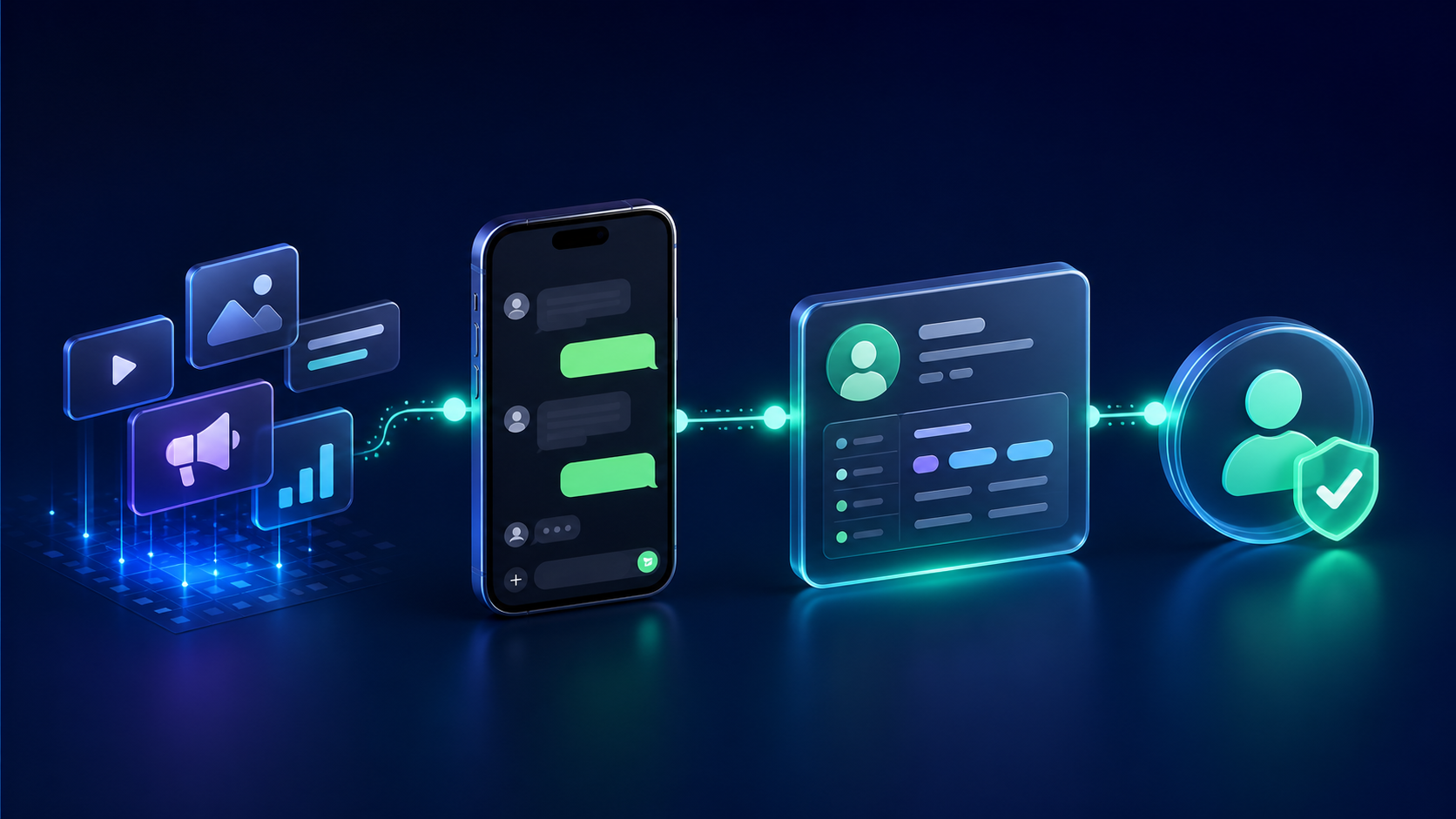
A WhatsApp click is not yet a qualified lead
WhatsApp is often the shortest path from an ad to a conversation for restaurants, hotels, clinics, property businesses and local services. Google Ads or Meta Ads generates traffic, a prospect opens a chat, and the platform reports a result. The difficulty is that “result” can mean a button click, an app open, a first message, a useful sales conversation, a booking or a paid order.
If a campaign optimises only for the easiest observable action, it can learn to find people who click without finding people who fit the offer. Measurement therefore needs two layers. The first is a technical conversion that proves an interaction happened. The second is a business status confirmed in a CRM, booking system or controlled lead sheet.
Neither advertising platform automatically understands the full WhatsApp conversation, the speed and quality of the sales response, or the final payment. A defensible setup does not claim perfect attribution. It creates a traceable evidence chain and makes its blind spots visible.
The minimum data chain to preserve
You do not need a complex enterprise CRM to start. You need one lead identifier and a consistent set of fields that survives the handoff from the website to WhatsApp and from the chat to the sales record.
- Acquisition source: Google, Meta, organic search, Maps, referral or direct, plus campaign and ad names.
- Click identifier: GCLID for eligible Google Ads clicks and the available Meta click or browser parameters.
- Landing context: entry URL, language, location, service and visit time.
- Contact point: the exact WhatsApp button, form, call link or other CTA used.
- Lead ID: a short internal reference that joins the web session, chat and CRM record.
- Lead status: new, valid, qualified, booked, won, lost, invalid or duplicate.
- Timestamps: first enquiry, first response, qualification and final outcome.
UTM parameters remain useful for reporting, but they are not proof of a sale and can be lost when a person changes device or returns later. Treat UTMs as one part of the chain alongside click IDs, a first-party Lead ID and human-confirmed sales feedback.
Two common WhatsApp journeys
The ad goes to a landing page first
This route gives the business more control. The landing page captures permitted campaign parameters, creates a short Lead ID and stores the relationship in a first-party system. The WhatsApp button can open a neutral pre-filled message such as: “Hi, I would like to ask about the service. Enquiry code: AD-7K4P.” The prospect sees a normal message, while the team can connect that code to the original visit.
Do not insert personal information, a long tracking URL or sensitive internal data into the message. The reference exists to join records, not to replace a natural conversation. It should also remain optional so the prospect can edit the text.
The ad opens WhatsApp directly
Meta messaging ads can remove the landing-page step and start the conversation directly. Native reporting can describe activity inside the platform’s observable journey, but lead quality still belongs in the business system. Without a disposition from the sales team, a dashboard knows how many conversations started, not how many matched the service area, budget, availability or buying intent.
Use the same definition of “qualified” across channels. Comparing a Google form submission with a Meta conversation start and calling both a lead creates a misleading cost comparison. The stages must be aligned before the media budget is aligned.
A practical lead-status model
The sales team will not maintain a taxonomy with dozens of ambiguous stages. A compact model is more valuable because it can be completed consistently.
- New: a message has arrived but has not been reviewed.
- Valid: a real person is asking about the relevant product or service.
- Qualified: the enquiry meets defined conditions such as location, need, availability or budget range.
- Booked: an appointment, table, call, viewing or visit is confirmed.
- Won: an order or payment can be verified.
- Lost: the lead was relevant but did not buy; a structured reason is recorded.
- Invalid: spam, recruitment, supplier outreach, wrong geography or unrelated demand.
Each status needs a factual rule. “Bad lead” is not a useful reason. “Outside our service area” tells the marketing team that targeting, location settings or ad copy may need attention.
Sending deeper outcomes back to Google Ads
Google supports offline conversion imports and Enhanced Conversions for Leads. Google’s documentation explains that uploaded offline outcomes can be matched using user-provided data, such as an email address or phone number in hashed form, and advertising identifiers when available. For a click-based GCLID implementation, the GCLID must be captured and stored with the prospect record.
Google changed this area in 2026: enhanced-conversion settings were unified, and current guidance directs new and future upload integrations towards Data Manager and the Data Manager API. A legacy tutorial that relies only on the Google Ads API may therefore be outdated for a new build. Check the current Google pages for Enhanced Conversions for Leads and offline conversions using GCLID before implementation.
Create separate conversion actions for meaningful funnel stages, such as Qualified Lead and Sale. Do not label the first WhatsApp message as a sale. A new offline event should initially be monitored for coverage, duplicates, delays and correct timestamps. Only use it as a primary bidding goal when the business can produce it consistently enough for the campaign’s decision cycle.
Returning lead quality to Meta
Meta Conversions API can send marketing events from a server, website or CRM. In a WhatsApp sales journey, that creates a route for a later qualification or sale event to reach the advertising system after the first conversation. The event should represent a real stage, use the correct event time and include only permitted matching parameters for which the business has a lawful basis.
When the same website event is sent through both the browser Pixel and Conversions API, use a shared event identifier and configure deduplication. Otherwise one action may be reported twice. The exact event fields and diagnostics can change, so confirm them in the official Meta Conversions API documentation and the Events Manager attached to the data source.
Hashing is a transport and matching control, not automatic permission to use customer data. Collect only what is needed, limit access, define retention, honour user choices and apply the privacy law relevant to the business and its customers.
Implementation sequence that reduces false confidence
- Define one business outcome. Write a testable definition of a qualified lead and name the role responsible for confirming it.
- Map the complete journey. Separate ad, landing page, WhatsApp click, first message, CRM record, booking and payment.
- Preserve acquisition data. Verify Google auto-tagging, UTMs and available platform identifiers before the user leaves for WhatsApp.
- Create the Lead ID. Join the visit to the conversation with a short reference or a supported integration.
- Standardise sales feedback. Make status and loss reason required; use a controlled list where analysis depends on consistent wording.
- Configure platform feedback. Start with test events and check diagnostics, timestamps, time zones and unique IDs.
- Reconcile three systems. WhatsApp conversations, CRM leads and platform conversions will not always be identical, but differences should have an explanation.
- Change bidding last. Do not optimise to a new event until completeness, delay and duplication are understood.
Metrics an owner can actually use
A decision-focused report shows spend, valid conversations, qualified leads, bookings, verified sales and loss reasons. It does not hide business outcomes behind clicks and impressions.
- Cost per valid conversation = spend / Valid leads.
- Cost per qualified lead = spend / Qualified leads.
- Qualification rate = Qualified / Valid.
- Booking rate = Booked / Qualified.
- Sales rate = Won / Qualified.
- First-response time = first response timestamp minus first message timestamp.
There is no universal good benchmark. The acceptable cost depends on gross margin, average order value, repeat purchase, capacity and close rate. Compare campaigns within the same business using the same stage definitions before comparing them with an industry anecdote.
Common causes of misleading WhatsApp attribution
- counting an app open or button click as a lead;
- overwriting the original source when the prospect returns directly;
- keeping UTMs but losing GCLID or other available identifiers;
- marking a lead Qualified automatically before sales review;
- sending every campaign to one number without a Lead ID;
- counting repeat customers and duplicate conversations as new acquisition;
- sending one event from browser and server without deduplication;
- comparing platform totals without accounting for different attribution settings;
- uploading customer data without clear permissions and access controls.
When to bring in Alex Digital
If campaigns already generate WhatsApp enquiries but no one can explain which ones became qualified opportunities, the priority is an end-to-end measurement audit. Alex Digital can review tagging, Google Ads, Meta Ads, landing pages, WhatsApp handoff, CRM stages and the management dashboard as one system. The broader approach is described on the Alex Digital website, with more practical material in the English blog.
For a consultation, contact Alex Digital on Telegram with your country, business type, advertising channels, current WhatsApp flow and where sales are recorded. We will begin with the data map and measurement limits, without promising a performance result before the evidence is checked.